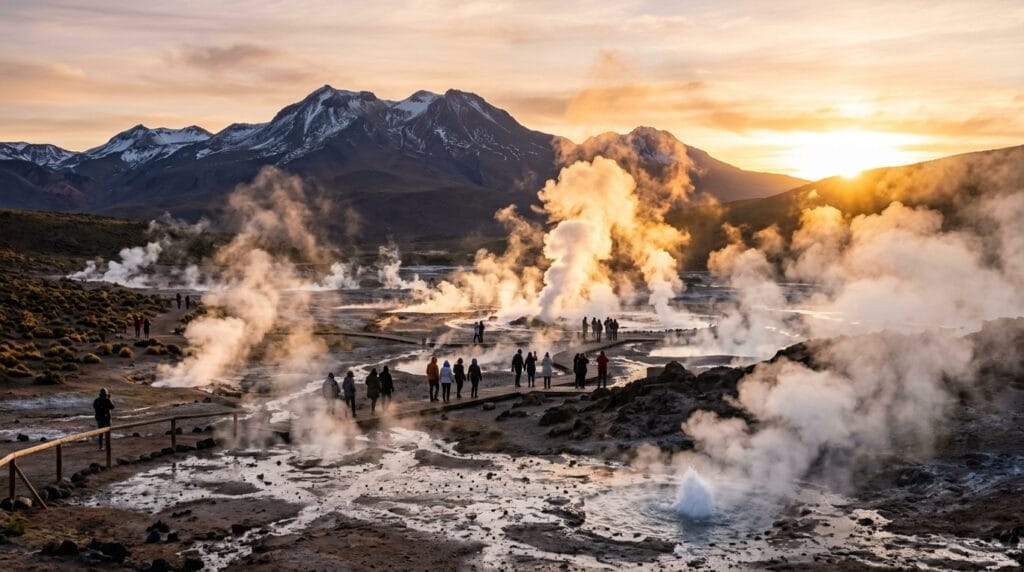
El Tatio Geysers: What the Reviews Actually Say About the Altitude (And Why the Real Risk Is Your Pickup)
Quick Answer
- Elevation: 4,300m (14,100ft) — acclimatise 2 nights in San Pedro first.
- Dawn temperature: -8°C documented in peak summer — pack a down jacket, not a fleece.
- #1 cause of 1-star reviews: logistics failures, not altitude.
- Ayllu accommodation: may not qualify for standard hotel pickup — confirm in advance.
- Tour duration reality: 7-9 hours door-to-door, not the “4 hours” some old listings claim.
- Entrance fee: ~15,000 CLP adults — bring cash, many tours don’t include it.
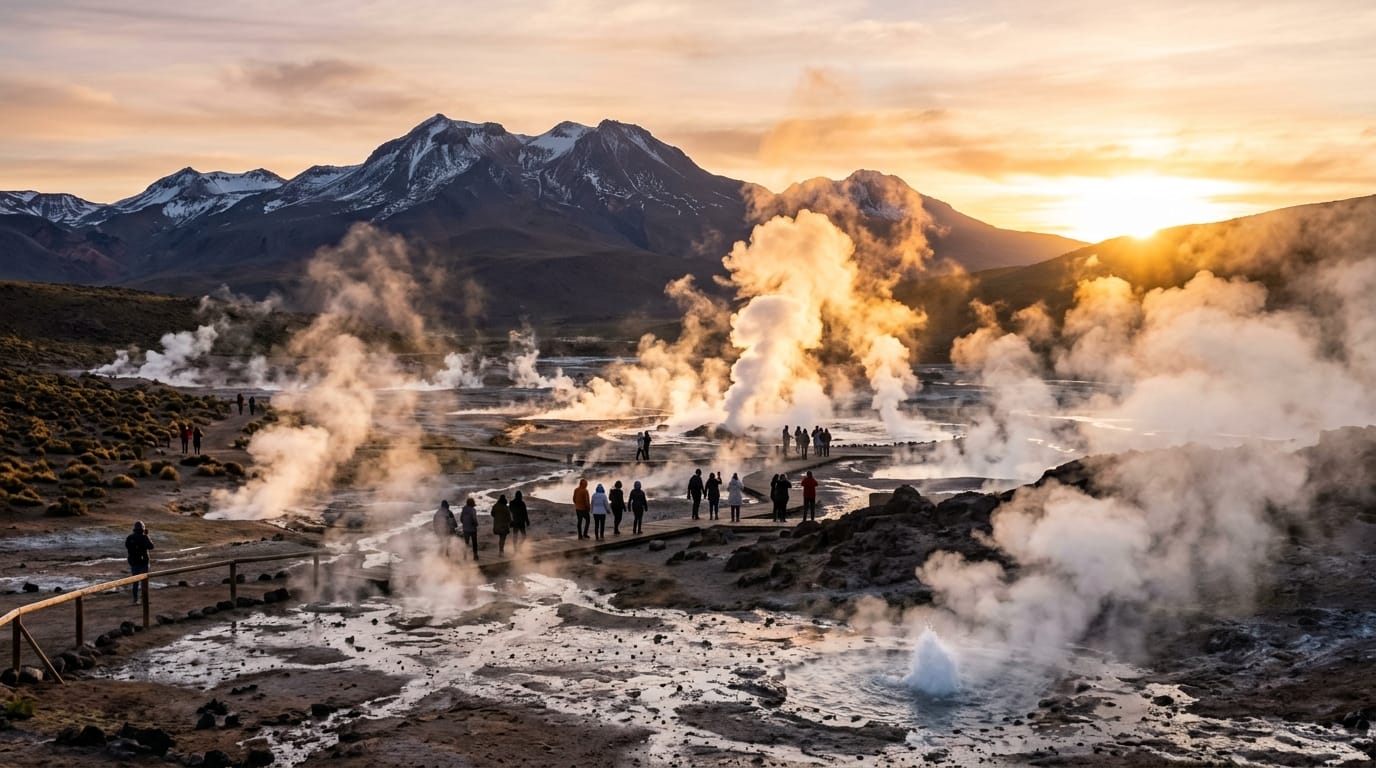
At 4,300 metres above sea level in the Chilean Altiplano, El Tatio Geysers is the world’s highest and third-largest geothermal field, trailing only Yellowstone and Russia’s Dolina Geizerov.
Its name, from the indigenous Kunza language, is generally translated as “the oven” or, in some readings, “the old man who cries.”
Every guide you read about visiting the geothermal field opens with altitude advice.
The elevation is real, the acclimatisation guidance is genuine, and preparation matters immensely. None of that is wrong.
But altitude is not what actually drives the worst reviews of tours to the field.
Logistics failures are — specifically missed pickups, incorrect meeting points, and the fact that a lot of popular accommodation around San Pedro de Atacama sits outside standard hotel pickup zones, something almost no other guide names explicitly.
This guide covers both, in the correct order of importance for actually having a good morning at the site.
The Altitude — What You Actually Need to Know
The site of The site sits at nearly 4,300 metres, comfortably above the threshold where unacclimatised travelers commonly start to struggle.
Symptoms reported by visitors who skipped acclimatisation range from headache and nausea to genuine difficulty catching a full breath after stepping off the bus — uncomfortable enough that even the on-site coca tea, widely used as a mild altitude aid, hasn’t been enough for some.
The fix isn’t complicated, it just requires patience most itineraries skip:
Spend a minimum of two nights in San Pedro de Atacama (2,407m) before your tour to El Tatio Geysers.
San Pedro is meaningfully lower than El Tatio Geysers, but high enough to begin real acclimatisation.
During those two days: move slowly, drink 3-4 litres of water daily, skip alcohol, and eat light.
Avoid heavy food and alcohol specifically the night before your excursion to the geothermal field, since both amplify altitude effects.
The temperature deserves its own paragraph.
One documented arrival at the site around 6:15 AM in early January — peak southern summer — recorded -8°C.
That’s not a worst-case outlier; it’s a reasonably typical dawn reading at the site.
A standard waterproof jacket is not sufficient at that temperature combined with wind off the geyser field.
Bring a proper down jacket, thermal base layers, waterproof gloves (not thin liner gloves), and a hat that covers your ears.
Standing next to an active vent in inadequate clothing at -8°C is one of the most commonly reported avoidable discomforts among visitors.
Coca tea is available on-site at the geysers and offered by most guides — coca leaves steeped in hot water, a traditional, mild aid for altitude discomfort.
It won’t resolve serious altitude sickness, but it can take the edge off a mild headache. Drink it hot, and don’t treat it as a substitute for proper acclimatisation.
The Real Risk: Logistics Failures
Here’s the pattern that doesn’t show up in most content about the region.
Across negative reviews on Viator and TripAdvisor for tours to the field, logistics complaints — not altitude — dominate the 1 and 2-star ratings.
The recurring themes:
Pickup confusion. Travelers report being given conflicting pickup information — hotel pickup confirmed, then denied, then a shifted time — with actual collection running well over an hour late in some documented cases, occasionally causing a same-day connecting tour to be missed entirely.
Tour duration overruns. Some older listings still advertise a “4-hour” tour to the geysers. Travelers who plan a same-day second activity around that figure have reported the actual tour running 5+ hours, with the resulting scheduling conflict left unresolved between the platform and the local operator.
In contrast, altitude-related complaints in the same review pool tend to rate the geysers itself highly despite personal discomfort — travelers who felt unwell but still praised the scenery.
The takeaway: acclimatisation advice is well known and travelers largely follow it. The pickup logistics gap is the thing that actually determines whether your morning goes smoothly.
The Ayllu Pickup Exclusion — What It Means for Your Booking
Ayllus are the traditional Atacameño community zones surrounding San Pedro — Quitor, Yaye, Sequitor, Solor, and Coyo among them.
Travelers frequently choose accommodation in these areas specifically because it’s quieter, more authentic, and often better value than the town centre.
The problem: many of these same travelers assume standard hotel pickup covers them for the geysers, and it often doesn’t.
Best Tours for the geysers
the geysers Sunrise Tour (Small Group, Max 15)
Our primary recommendation for visiting the geothermal field. Hotel pickup runs roughly 5:00-5:40 AM in summer and 4:30-5:10 AM in winter, capped at 15 travelers for a more manageable group at the geyser field than larger minibus tours. Breakfast is included on-site, and the itinerary adds a Machuca village stop on the return. This listing explicitly states the ayllu pickup exclusion in its own terms — confirm your meeting point before booking if you’re staying outside San Pedro’s urban zone.
Check availability on Viator →Geysers del Tatio (English / Portuguese / Spanish)
The most extensively reviewed excursion to the geothermal field on Viator, with guiding available in three languages. Hotel pickup around 5:00 AM to reach the field for sunrise, with the same breakfast-and-Machuca structure as the primary option. The higher review count makes this the statistically safer bet on consistency if you’re deciding between similarly priced options.
Check availability on Viator →Tatio Geysers and Machuca (Full Day, with Thermal Spring Stop)
A fuller-day version of the standard itinerary that adds a stop at Pozón Rústico thermal spring alongside the geysers and Machuca village. A solid pick if you want the hot-springs stop built into a slightly more relaxed schedule rather than a tight sunrise-and-back itinerary.
Check availability on Viator →Semi-Private Tour: Tatio Geysers, Machuca Village & Rio Putana Wetlands
A smaller-group option that adds a stop at the Putana River wetlands — good for Andean wildlife spotting (vicuñas, flamingos in season) — on top of the standard the geysers and Machuca stops. For travelers who want a smaller group and one extra stop without paying for a fully private vehicle.
Check availability on Viator →Tour Comparison
| Tour | Reviews | Group Size | Notable Extra |
|---|---|---|---|
| Sunrise Tour, Max 15 (`d5499-6315CJCTATIO`) | 178 | Max 15 | Hot springs stop, breakfast |
| Geysers del Tatio (`d5499-69506P8`) | 258 | Standard | 3 languages, highest review count |
| Tatio Geysers & Machuca (`d5499-44142P1`) | 55 | Standard | Pozón Rústico thermal spring |
| Semi-Private + Rio Putana (`d5499-3851P70`) | 45 | Smaller group | Wildlife-focused wetlands stop |
Our recommendation: for solo or paired travelers wanting the best statistical odds of a consistent experience, book the highest-reviewed option for the geysers.
If a smaller group and an extra wildlife-focused stop matter more to you than price, the semi-private option is worth the modest premium.
Either way, resolve your pickup logistics before your tour date, not the morning of.
The Pre-Tour Checklist (Night Before)
- Confirm your pickup time and meeting point in writing with the operator, via WhatsApp if that’s their channel. Don’t assume — ask explicitly.
- Check your accommodation’s ayllu status. Urban zone or outlying community? Confirm your exact meeting point for the geysers either way.
- Skip alcohol. At 4,300 metres, alcohol meaningfully amplifies altitude effects — the night before the geysers isn’t the night for a pisco sour.
- Drink 2-3 litres of water across the day before, and bring a filled bottle on the tour.
- Set two alarms. A missed 4:30 AM pickup is generally not recoverable same-day.
- Lay out your gear: down jacket, thermal base layers, waterproof gloves, warm hat, sturdy shoes, cash for the entrance fee. Swimwear and a towel if you’re doing the hot springs.
The Hot Springs Decision
A designated swimming area exists at the site, with water around 38°C — comfortably warm.
The catch is the air temperature outside the pool, which can sit well below freezing at the same moment.
Exiting a 38°C pool into documented -8°C air is a genuine temperature shock, and it rewards specific preparation: dry clothes and a towel laid out and within arm’s reach before you get in, so the transition out of the water is fast.
This isn’t a reason to skip the hot springs — the contrast of warm water, freezing air, and active geysers steaming nearby is a genuinely unusual experience — it’s a reason to prepare for the exit, not just the entry.
Machuca Village Stop
Most full-day tours to the field include a 20-30 minute stop at Machuca, a small Atacameño village at around 4,000 metres on the return drive, home to a handful of residents, a well-known small wooden church, and thatch-roofed adobe buildings.
Local vendors sell llama and alpaca meat skewers, empanadas, and coca leaf products — a worthwhile cultural counterpoint to the geothermal spectacle earlier in the day, typically included in the standard tour price with food purchases at your own expense.
Getting to El Tatio and San Pedro de Atacama
The site sits roughly 90km north of San Pedro de Atacama, a 1.5-2 hour drive along a route that’s paved for part of the way and unpaved and rough for the final stretch — potholes, loose rock, and uneven surfaces that make a standard passenger car a poor choice.
Tour operators use appropriately equipped 4×4 vehicles for this reason.
If you’re prone to motion sickness, request the front passenger seat when boarding and take any travel sickness medication the night before rather than the morning of, since it needs time to take effect.
San Pedro’s nearest commercial airport is Calama (CJC), roughly 1.5 hours away by road.
Frequently Asked Questions About El Tatio
Is altitude sickness a serious risk at the geysers?
Yes — genuinely so at 4,300m. Two nights acclimatising in San Pedro (2,407m) first, 3-4L water daily, and no alcohol the night before are the core mitigations.
What actually causes most 1-star reviews of the geysers tours?
Logistics failures — pickup confusion, ayllu meeting-point issues, and tour duration overruns — outnumber altitude complaints in negative review analysis.
What does ayllu accommodation mean for the geysers pickup?
Ayllus are community zones outside San Pedro’s urban centre. Several operators exclude them from standard hotel pickup — confirm your meeting point directly with your operator if staying in Quitor, Yaye, Sequitor, Solor, or Coyo.
How cold is it at dawn at the geysers?
Around -8°C has been documented even in peak summer. Pack a down jacket and waterproof gloves, not just a fleece.
How long does the tour to the geysers actually take?
7-9 hours door-to-door is realistic, despite some older listings advertising 4 hours. Don’t book anything else for that morning or afternoon.
Can you self-drive to the geysers?
The final stretch is rough, unpaved terrain best suited to a 4×4. Possible with the right vehicle and experience; a guided tour removes the risk for first-time visitors navigating in pre-dawn darkness.
Related Travel Reading
- Explore our Railay Beach November 2026 Guide.
- Chasing Northern Lights? Read our Abisko vs Rovaniemi Northern Lights 2026 Guide.
- Snorkeling cold waters? Read our Silfra Fissure Iceland Snorkeling Guide.