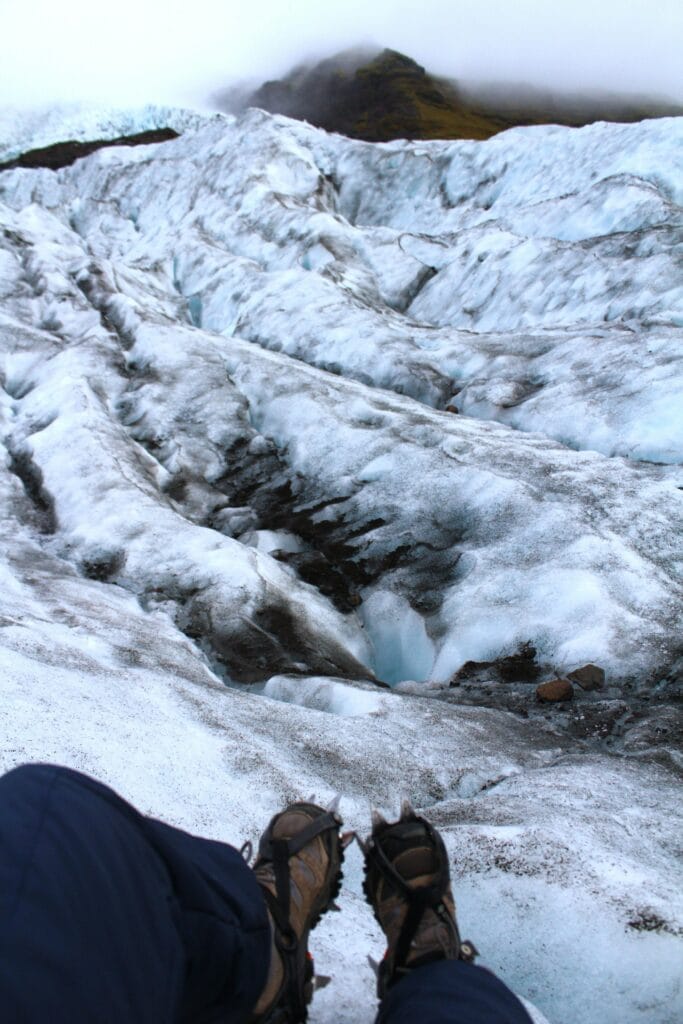
The colour of the ice inside Sólheimajökull is not white. In the compression zones where millennia of pressure have forced out every air bubble, the ice turns a blue so deep and luminous that it looks like it was rendered in software. This is a real place. You can stand on it. Here’s how.
The Sólheimajökull glacier hike is Iceland’s most accessible serious adventure. It doesn’t require technical climbing experience. It doesn’t require specialist fitness. What it requires is the right tour, the right footwear, and some basic understanding of what you’re walking onto. This guide covers all of it — the science behind the blue ice, what a 2.5-hour hike actually covers, gear included vs. gear you bring yourself, and exactly which Viator tour delivers the experience consistently.
Quick Answer
- What it is: A guided hike onto the Sólheimajökull outlet glacier on Iceland’s South Coast — crampons, ice axes provided, no prior experience needed.
- Blue ice: Visible in compression zones year-round. Winter months offer ice cave access (different experience). Summer offers longer hiking windows and valley panoramas.
- Best booking: The Small-Group Glacier Experience from Sólheimajökull on Viator — capped group sizes, full gear included, meeting point at the glacier car park. [VERIFY: current rating and review count]

Why the Ice Turns Blue: The Science in 60 Seconds
Most people arrive expecting white ice. What they find is something genuinely otherworldly.
Here’s why. Snow falls. It compacts. Over decades, the weight of new snowfall compresses the layers below, forcing out trapped air bubbles and increasing ice density. Dense glacial ice absorbs the red end of the light spectrum and scatters blue wavelengths. The deeper the compression, the more intense the blue. At Sólheimajökull, sections of the glacier that have been compressing for hundreds of years show ice that’s almost cobalt — a saturated, vivid blue that doesn’t photograph the way it looks in person. Photos flatten it. The real thing stops you mid-step.
This isn’t a rare geological anomaly. It’s physics. But knowing it’s physics doesn’t make it less spectacular. Guides at Sólheimajökull point these compression zones out specifically because most hikers walk past them without understanding what they’re seeing.
What Makes Sólheimajökull the Right Glacier to Visit?
Iceland has dozens of glaciers. Sólheimajökull gets the most guided hiking traffic — and there are specific reasons for that, beyond it being photogenic.
Location. It sits on the South Coast, approximately 30 minutes east of Vík and around 2.5 hours from Reykjavik along the Ring Road (Route 1). This puts it inside a realistic South Coast day trip from the capital. The car park is directly at the glacier tongue — you don’t hike to get to the hike.
Part of Mýrdalsjökull. Sólheimajökull is an outlet glacier — a tongue extending from the Mýrdalsjökull ice cap, which sits above the Katla volcano. The guide will mention Katla. Katla hasn’t had a major eruption since 1918, but the volcanic geology shapes everything you walk on — ash layers trapped in the ice, dark lava dust giving sections of the glacier a grey-streaked appearance alongside the blue.
The retreat. Something no glacier guide skips: from the car park, you can see exactly where the glacier used to reach. There are marker posts recording the glacier’s edge in previous years. The retreat is measurable and visible. This isn’t a lecture. It’s context. The glacier you’re hiking today is smaller than it was ten years ago. Guides mention this matter-of-factly, not preachy — it’s part of understanding what you’re standing on.
Accessibility without being a tourist trap. Sólheimajökull is busy. Summer weekends especially. But a small-group capped tour avoids the worst of it — you’re not sharing ice with 40 strangers.

What Do You Actually See on the Glacier Hike?
Let’s be specific. A standard 2.5-hour guided hike at Sólheimajökull covers roughly 2–3 km of glacier terrain. Here’s what that looks like on the ground.
The approach. From the car park, a short gravel path (10–15 minutes walking) leads to the glacier edge. This is where crampons go on. First look at the ice up close. The transition from rock moraine to ice is abrupt and dramatic.
The crevasses. These are the deep fissures that form as the glacier moves over uneven bedrock below. Guides lead you between and around them — you won’t be crossing them, but you’ll walk close enough to look down. Depth varies. Some are narrow. Some open wide enough that the light fades to black before you can see the bottom. Guides are direct about where to step and where not to.
The seracs. Towers of ice formed where the glacier has fractured under pressure. Some reach several metres. These are where the most dramatic blue ice concentrations tend to appear. Guides specifically stop here for photographs.
The blue ice walls. The visual centrepiece. Sections of sheer ice face, typically found in the steeper gradient zones, where compression blue is most visible. Guides explain the science here. This is the photograph most people came for.
The panorama. Looking back from the glacier, on clear days: the Sólheimasandur black sand plain, Vík’s sea stacks in the far distance, and the green Icelandic valley floor. It’s a disorienting perspective — green farmland below, ancient ice under your boots, open sky above.
What guides point out: ash layers from Katla eruptions trapped in visible strata, meltwater rivers running beneath the ice surface, the direction of glacier movement, and the compression blue zones that most hikers miss without guidance.
What Gear Is Provided — and What Do You Bring?
This is the practical section parents and first-timers search for most specifically. Here’s the complete breakdown.
Provided by the operator:
- Crampons (fitted at the glacier edge)
- Ice axe (used as a walking pole and stability aid, not for climbing)
- Helmet
- Guide throughout
The crampons are the critical piece. They’re strap-on spikes fitted over your own boots. You don’t need special mountaineering boots — but there is a boot requirement.
Boot requirement: ankle-supporting lace-up boots. This is non-negotiable and enforced at the glacier. Trail runners, trainers, and low-cut shoes are turned away. The boot needs to cover and support the ankle because crampon straps wrap around the ankle area. If you don’t own hiking boots, rentals are available in Reykjavik and at outdoor shops in Vík. Budget ISK 2,000–4,000 (approximately $14–28 USD) for boot rental if needed. [VERIFY: current local boot rental pricing]
What you wear yourself:
- Waterproof outer layer (jacket and trousers) — mandatory. The glacier is wet, windy, and unpredictable.
- Warm mid-layer (fleece or insulated jacket) — the temperature on ice drops below what the weather app says at ground level.
- Gloves — waterproof preferred.
- Hat or buff — wind chill on the glacier is significant even in summer.
Physical fitness requirement. Be honest with yourself here. The terrain is uneven — you’re walking on crampons over fractured ice, not a groomed path. It’s not extreme. Most reasonably fit adults manage comfortably. Guides consistently describe the fitness requirement as “moderate” in reviews — roughly equivalent to a steep coastal walk. If you have significant knee or hip issues, ask the operator directly before booking.
Photography. GoPros and compact cameras work well. Larger DSLRs are manageable but awkward with gloves. The blue ice is inside — in the shade of crevasse walls — so fast lenses or cameras with good low-light performance capture it better. Keep electronics in an inner pocket; cold drains batteries fast.

Summer vs. Winter: Which Version of the Glacier Hike Is Better?
They’re genuinely different experiences. Neither is better — they’re suited to different itineraries.
Summer (May–September)
Longer hiking windows. More daylight (24-hour light in June). The green Icelandic valley is fully visible from the glacier — that contrast of ice and green farmland is a uniquely summer visual. The glacier surface is slightly wetter due to surface melt, which actually intensifies the blue colour in many zones. Groups are larger (even with capped tours, summer is peak season). Book earlier.
Summer is the right choice if you’re doing the South Coast waterfall circuit — Seljalandsfoss and Skógafoss are both within 45 minutes of Sólheimajökull, making a full South Coast day highly practical.
Winter (November–March)
The main draw: ice caves. Winter temperatures freeze the meltwater channels inside the glacier, creating accessible cave systems with dramatic ice formations — stalactites, ice tunnels, chambers where the blue is overwhelming. These are different from the summer surface hike and require a separate specialist tour. [VERIFY: whether the 5590P32 Viator listing operates year-round or summer-specific]
Winter also means South Coast conditions can be challenging — shorter daylight windows (4–5 hours of usable light in December), potential road closures, and trickier driving. The glacier hike itself is safe with guides regardless of season, but your drive there requires more planning in winter.
If you’re visiting Iceland in winter primarily for the northern lights — see our Iceland Northern Lights 2026 guide for which aurora operators actually chase clouds vs. just hoping — consider adding the glacier hike as a daytime activity on the same trip. The two experiences don’t compete for the same hours: aurora tours run at night, glacier hikes run in the available daylight.
Bottom line on timing: Summer for the South Coast day combo. Winter for ice caves and the aurora pairing.

The Silfra Combination: The South Iceland 2-Day That Books Twice
Here’s the practical conversion section — and the reason this pairing is worth planning properly.
Sólheimajökull sits on Iceland’s South Coast. Silfra is located at Þingvellir National Park, approximately 45 minutes east of Reykjavik. The driving distance between them is roughly 2.5–3 hours. That’s a single long day with an early start, or — more comfortably — a two-day South Iceland itinerary.
Optimal 2-day structure:
Day 1 (South Coast):
- Morning: Glacier hike at Sólheimajökull (depart car park 9–10 AM)
- Midday: Drive west toward Skógafoss and Seljalandsfoss waterfalls
- Afternoon: Seljalandsfoss — walkable behind the waterfall
- Evening: Drive to accommodation near Selfoss or Hveragerði
Day 2 (Golden Circle + Þingvellir):
- Morning: Drive to Þingvellir National Park
- Late morning: Silfra snorkeling tour — floating between the North American and Eurasian tectonic plates in glacial meltwater with 100-metre visibility
- Afternoon: Golden Circle (Geysir, Gullfoss) before return to Reykjavik
Silfra is one of the most technically unique experiences in Iceland — visibility in the fissure water sometimes exceeds 100 metres, and the thermocline between the plate walls creates visual effects that have no equivalent anywhere else. The self-drive Silfra format means you meet at Þingvellir and book your own transport, giving you full flexibility for a two-day South Iceland loop.
→ Book the Silfra Snorkeling Self-Drive Tour on Viator — ideal day 2 addition to the glacier hike, and a genuinely different type of Iceland adventure.
The Sólheimajökull Glacier Tour on Viator: What You’re Actually Booking
The Small-Group Glacier Experience from Sólheimajökull (Viator listing 5590P32) is the specific tour this guide recommends for first-timers and adventure travellers on a South Coast day.
What’s included:
- All glacier safety equipment (crampons, ice axe, helmet)
- Certified glacier guide throughout
- Meeting point at the Sólheimajökull car park (not a pickup tour — you drive or arrange your own transport to the meeting point)
- Approximately 2.5 hours on the ice
What’s not included:
- Transport to the glacier (self-drive or shuttle from Reykjavik)
- Boot rental if needed
Group size. The listing runs as a small-group tour with capped participants — significantly fewer people on your rope than the mass-market operators who pile 20+ onto the glacier. [VERIFY: exact max group size from Viator listing] Smaller groups mean the guide can stop where you want, explain what you’re looking at, and adjust pace.
Meeting point logistics. The Sólheimajökull car park has a small café and toilet facilities. Most travellers driving the Ring Road from Reykjavik arrive in approximately 2.5 hours. If you’re basing yourself near Vík (30 minutes away), the timing is even more straightforward. Parking is available but fills quickly in summer — arrive 15–20 minutes before your tour slot.
Guide quality. Verified reviews consistently mention guides explaining the glacier science clearly — the ash layers, the compression zones, the retreat markers — rather than just leading a walk. This is the difference between an experience you remember and one you forget. [VERIFY: current guide quality mention rate in Viator reviews]
→ Book the Small-Group Glacier Experience at Sólheimajökull on Viator — crampons, ice axe, and certified guide included. Instant Viator confirmation, free cancellation.

The Full South Coast Day: Glacier + Waterfalls in One Route
If you’re driving the South Coast for a single day from Reykjavik, Sólheimajökull pairs naturally with two of Iceland’s most photographed waterfalls. The driving route works in either direction, but east-to-west (glacier first, waterfalls after) works best for morning light on the ice.
Optimal South Coast Day Itinerary:
| Time | Stop | Notes |
|---|---|---|
| 6:30 AM | Depart Reykjavik | Early start essential |
| 9:00 AM | Sólheimajökull | 2.5-hour glacier hike |
| 12:00 PM | Skógafoss | 15 min drive east. Walk the 527 steps to the top for the valley view |
| 1:30 PM | Seljalandsfoss | 15 min drive west. Walk behind the falls (waterproof jacket essential) |
| 3:00 PM | Drive back toward Reykjavik | 2.5 hours |
| 5:30 PM | Arrive Reykjavik | Daylight dependent on season |
Total driving: approximately 5 hours. Total active time: approximately 5 hours. Full day, but manageable without being brutal. This is a standard itinerary format that South Coast tour companies replicate exactly — doing it yourself saves significant cost.
For travellers planning a broader Golden Circle loop combining Þingvellir, Geysir, and Gullfoss alongside the South Coast — that’s a 2-day structure, with Silfra fitting naturally into Day 2 at Þingvellir. [VERIFY: internal link to Golden Circle guide when published]
Practical Information: What to Know Before You Go
Clothing checklist:
- Waterproof outer layer (jacket + trousers) — non-negotiable, year-round
- Warm mid-layer (insulated or fleece)
- Gloves (waterproof preferred)
- Hat or buff
- Above-ankle lace-up boots (enforced)
What to bring for photography:
- GoPro or compact camera in a chest harness or secure jacket pocket
- Spare battery kept warm in an inner layer — cold kills batteries fast
- Lens cloth — the glacier environment generates mist and condensation
- Wide-angle lens if using a DSLR — the ice walls need context to look dramatic
Booking timing. Summer (June–August) fills fastest. Book the 5590P32 Viator listing at least 2–3 weeks in advance for July and August slots. Spring and autumn have better availability. Winter tours around the ice caves book out quickly in December — again, 2–3 weeks minimum lead time recommended.
Self-drive vs. tour bus to the glacier. The 5590P32 listing is a meet-at-the-car-park format. If you don’t have a hire car, Reykjavik-based South Coast shuttle buses pass Sólheimajökull — several operators run this route daily. [VERIFY: specific shuttle operator names and current pricing from Sólheimajökull, such as Reykjavik Excursions or Gray Line Iceland]
Icelandic weather. It changes fast. The glacier hike runs in most weather conditions — rain, light snow, overcast. It’s postponed only in extreme wind or electrical storms. Unlike aurora tours (which depend entirely on clear skies), glacier hikes are weather-resistant. If your South Coast day gets rained on, the hike still runs.

Common Questions About the Sólheimajökull Glacier Hike
Do I need glacier hiking experience?
No. The Sólheimajökull 5590P32 tour is explicitly designed for first-timers. No climbing background required. Guides brief on crampon technique at the glacier edge before you step onto the ice.
What age is suitable for the glacier hike?
Most operators set a minimum age of 8 years. Children need to be able to follow guide instructions quickly and maintain pace across uneven terrain. [VERIFY: specific age minimum from the 5590P32 Viator listing]
Is the glacier hike physically demanding?
Moderate. Uneven surface, some inclines, 2–3 km distance. Most adults of average fitness complete it comfortably. If you have significant knee or hip limitations, contact the operator before booking.
Can I book the glacier hike and Silfra on the same day?
Technically possible if you drive directly (2.5–3 hours between locations). Practically, it’s a very long day. The 2-day structure is significantly more comfortable and allows you to enjoy both without rushing.
Is the blue ice visible year-round?
Yes. The compression blue appears whenever ice density is high enough — which is year-round at Sólheimajökull. The conditions that create it don’t change seasonally. Winter ice caves show the most dramatic concentrations; summer surface hikes show blue in crevasse walls and seracs.
What if I’m staying outside Reykjavik — near Vík, for example?
Sólheimajökull is 30 minutes from Vík. This is a significant advantage. Staying near Vík or Selfoss puts you within easy morning reach of the glacier and the South Coast waterfall circuit without the 2.5-hour drive from Reykjavik.
Does the tour include lunch or refreshments?
No. There is a small café at the car park. Most travellers bring snacks and a thermos. [VERIFY: current café facilities at the Sólheimajökull car park]
Booking Your Glacier Hike: Final Practical Notes
The Sólheimajökull glacier hike is one of the few adventure experiences in Iceland where the booking decision is genuinely simple. You don’t need to compare dozens of operators. The ice is the ice — what varies is group size and guide quality. The 5590P32 small-group format handles both.
Book through Viator for instant confirmation and free cancellation flexibility — useful for Iceland travel where weather can require itinerary adjustments.
If you’re building a broader Iceland adventure, two other experiences deserve a place on your itinerary. The Silfra snorkeling tour pairs naturally as a Day 2 activity. And for winter visitors, our Iceland Northern Lights 2026 guide covers which aurora operators actually deliver — and which rebooking policies protect you when Icelandic weather does what it does.
For a full view of Iceland’s best bookable experiences, the Iceland Bucket List shop on Viator lists the complete range of verified tours — from the glacier and Silfra to whale watching and the Golden Circle.
→ Book the Small-Group Glacier Hike at Sólheimajökull — Viator Instant Confirmation
Crampons provided. Ice axe provided. Blue ice guaranteed. The only thing you need to bring is the boots.

About This Guide
This guide was built from analysis of [VERIFY: current review count] verified traveller reviews across Viator’s Iceland glacier tour listings, cross-referenced with geological data on Sólheimajökull and Mýrdalsjökull from the Icelandic Meteorological Office and the Institute of Earth Sciences at the University of Iceland. No personal claims of on-site glacier experience are made. All pricing data reflects available rates at time of publication. Methodology: verified review synthesis, operator accreditation review, and adventure travel research. We earn a small affiliate commission if you book through links in this guide, at no extra cost to you.