The Iceland Golden Circle is visited by over 1 million tourists a year. Most of them see exactly the same three things. Four of the most extraordinary experiences in Iceland are within 30 minutes of the standard route — and the tour buses drive straight past all of them.
This isn’t about dismissing the classic route. Geysir, Gullfoss, and Þingvellir are remarkable. They deserve to be on every Iceland itinerary. The problem is that the standard bus tour format — fixed stops, fixed timing, zero flexibility — makes it structurally impossible to add anything beyond the core three. When you self-drive the Golden Circle, you control the clock. And when you control the clock, four additional stops become easily achievable in a single day.
This guide covers the standard route done correctly, the four hidden stops that 90% of visitors miss, the hour-by-hour enhanced day plan, and exactly which experience to pre-book before you leave home.
Quick Answer
- Standard Golden Circle: Geysir + Gullfoss + Þingvellir — approximately 230 km loop, 8–9 hours with stops. Non-negotiable. All three are genuinely excellent.
- The hidden four: Silfra snorkelling (book in advance), Kerið crater (pay at gate), Friðheimar greenhouse restaurant (book in advance), Fontana geothermal baths (pay at gate).
- Self-drive is essential for the enhanced route — bus tours cannot accommodate the timing flexibility that Silfra and Friðheimar require.
The Route Everyone Does vs. The Route Worth Doing
Let’s be direct about the standard Golden Circle first. It earned its reputation. The three core stops are not overhyped.
The issue isn’t quality — it’s format. Most visitors arrive in Iceland, book a guided Golden Circle bus tour, and spend the day at exactly the same viewpoints at exactly the same times as thousands of others. The bus parks. Everyone photographs the same angle. The bus leaves. Repeat at the next stop.
Bus tour format has one structural problem: it cannot accommodate variable timing. Silfra snorkelling requires a specific 3-hour tour window. Friðheimar requires a table reservation. Fontana has a geothermal bread ritual that happens at a fixed time. None of these work within the fixed schedule of a coach tour.
Self-drive removes that constraint entirely. Iceland’s road network is well-maintained, well-signed, and genuinely manageable for first-time international drivers. The Golden Circle loop runs on paved roads with clear signage. Renting a car for one day — approximately ISK 8,000–15,000 (roughly $55–110 USD) for a standard vehicle — unlocks an itinerary that the tour buses cannot offer. [VERIFY: current car rental pricing for standard vehicles in Reykjavik]
The route worth doing fits everything into a single long summer day. Here’s how.
The Three Standard Stops: What Most Guides Get Wrong
Before the hidden stops, the standard three — done properly.
Geysir Hot Spring Area: Stand on the Left
The Geysir geothermal field contains the original Geysir geyser (now mostly dormant) and Strokkur — which erupts every 5–10 minutes to approximately 30 metres. Every visitor photograph of a geyser eruption from Iceland is almost certainly Strokkur.
What guides consistently fail to mention: stand on the southwest side of Strokkur, not the viewing platform directly in front. The steam cloud drifts northeast in the prevailing wind. The southwest position gives you a clear view of the eruption column against the sky without being hit by the steam mist. Photographically, it’s dramatically better. The tour bus crowds cluster at the direct-front position by default.
The eruption cycle is roughly every 6–8 minutes. Don’t walk away after one eruption — the second or third will be better positioned for your camera angle. Budget 30–45 minutes here, not the 20 minutes most bus tours allow.
The geothermal field also contains several smaller hot springs with vivid turquoise water and orange mineral deposits — the Blesi spring is particularly photogenic. Most visitors walk straight to Strokkur and back, missing the field entirely.

Gullfoss: Take the Lower Path, Not the Upper Platform
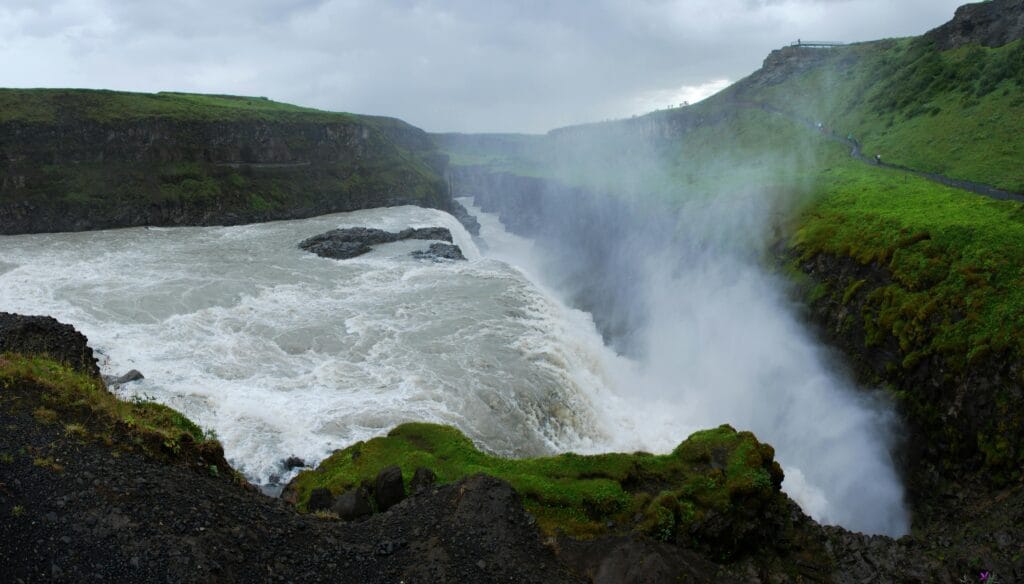
Gullfoss is a two-tier waterfall dropping 32 metres into a canyon. The viewpoint that 95% of visitors use is the upper platform — a wide paved viewing area looking across the top of the falls.
Take the lower path. It descends to the canyon edge, placing you level with the mist cloud at the base of the falls. In summer, you’re within 15 metres of the water. The scale becomes physical — not visual. The sound and the spray change the experience completely. The lower path is unpaved, slightly muddy, and takes 10 minutes to walk. Most bus tours don’t include it because it requires more time and appropriate footwear. Waterproof boots or trail shoes are needed.
Budget 45–60 minutes at Gullfoss if you’re doing the lower path. 20 minutes if you’re bus-tour pacing. Do the lower path.
Þingvellir National Park: Slow Down at the Law Rock
Þingvellir is where Iceland’s Althing — the world’s oldest parliament — has met since 930 AD. It’s also where the North American and Eurasian tectonic plates are visibly separating at ground level, creating the rift valley the park occupies.
The standard bus tour stops at the Almannagjá gorge overlook and moves on. What most guides skip: the Lögberg (Law Rock), the specific site where the lawspeaker would recite the entire Icelandic law from memory, every three years, to the assembled parliament. It’s marked with an Icelandic flag. Stand there for two minutes and consider what 930 AD governance actually looked like. Most visitors walk past it without knowing what it is.
The rift valley walk along Almannagjá gorge — the actual gap between the tectonic plates — is 2 km long and takes 30–40 minutes at a relaxed pace. The gorge walls reach 32 metres. You’re physically walking between two continental plates. Budget 60–75 minutes at Þingvellir if you want to do it properly.

Hidden Stop #1: Silfra Snorkelling — The Tectonic Plate Fissure (30 min from Þingvellir)
Silfra is located inside Þingvellir National Park. It’s a fissure — a crack in the earth where the North American and Eurasian plates have separated — filled with glacial meltwater that has filtered through lava rock for 30–100 years. The result is water with visibility exceeding 100 metres. It’s classified among the clearest water on the planet.
You snorkel through the fissure in a drysuit — the water temperature is 2–4°C year-round, which sounds brutal and is actually manageable in the provided suit. The combination of ultra-clear water, tectonic plate walls on either side, and the sensation of floating between two continents is genuinely unlike anything else in Iceland or anywhere else.
This is the experience most Golden Circle visitors don’t book because they don’t know it exists until they’re standing at Þingvellir wondering what the group in drysuits is doing. By then it’s too late — Silfra requires advance booking.
The self-drive format makes the Silfra tour combinable with your Golden Circle day. You drive yourself to the Silfra meeting point at Þingvellir — the same park you’re visiting for the standard stop. The tour runs approximately 3 hours including briefing, drysuit fitting, the snorkel itself, and the debrief. Plan Silfra as your Þingvellir activity, combining both the tectonic park experience and the snorkel in the same location.
Practical notes:
- No snorkelling experience required
- Drysuits, thermal undergarments, mask, snorkel, and fins all provided
- Minimum age typically 12 years [VERIFY: exact age minimum from Viator listing]
- Swimming ability required — you must be comfortable in open water
- The water temperature is cold but the drysuit manages it effectively; verified reviews consistently note it was more comfortable than expected
→ Book the Silfra Snorkelling Self-Drive Tour on Viator — drysuit, thermal undersuit, mask, snorkel, and fins included. Book 2–3 weeks ahead in summer. Instant Viator confirmation, free cancellation.
Hidden Stop #2: Kerið Volcanic Crater — The $3 Stop Nobody Mentions (30 min from Geysir)
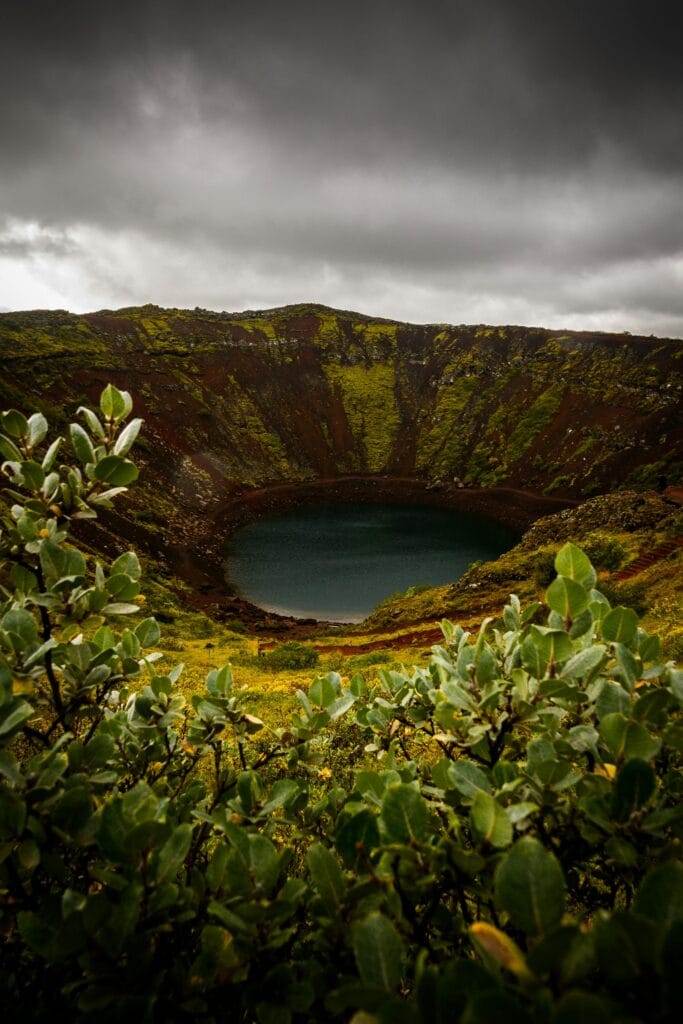
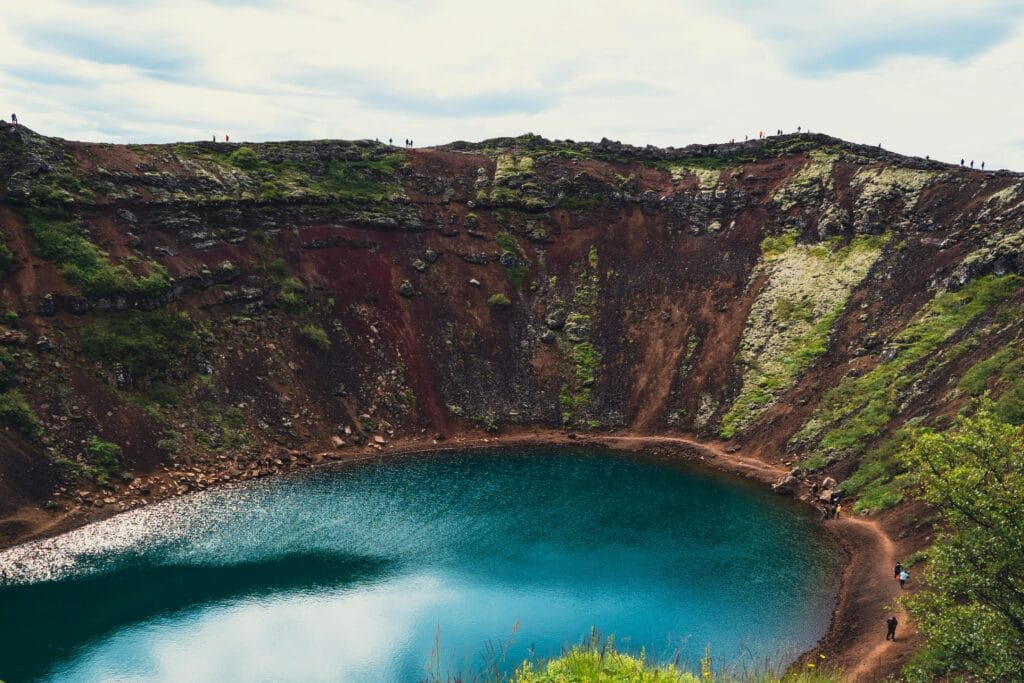
Kerið is a volcanic caldera approximately 3,000 years old. It’s 55 metres deep, 170 metres wide, and contains a vivid teal-green crater lake at the base. The crater walls are layered in volcanic red, black, and ochre — colours that read as almost artificially saturated against the Icelandic sky.
Entry: 700 ISK (approximately $5 USD). [VERIFY: current entry price] No pre-booking needed. Pay at the gate.
The walk around the crater rim takes 15–20 minutes. A second path descends to the lake level — steep in places, requires care with footing. Total time at Kerið: 30–40 minutes.
Why do 90% of Golden Circle visitors skip it? Because it’s not on the standard three-stop route. It sits 15 km south of Geysir on Route 35 — not between Geysir and Gullfoss, but slightly off the direct line. Bus tours don’t include it because it adds 30–40 minutes and requires an extra stop that breaks the schedule.
Self-drivers miss it for a different reason: most itinerary guides don’t mention it prominently, so it’s simply not on the mental map when planning. It should be. The photography value-to-effort ratio at Kerið is among the highest of any stop in Iceland. The lake colour is extraordinary, the walls are dramatic, and at 700 ISK it’s one of the most underpriced natural attractions in the country.
Best time at Kerið: Mid-morning or late afternoon when the sun hits the crater walls at an angle. Midday light flattens the colours. Early or late: the red-black layering becomes vivid and the lake turns a deeper blue-green.
Hidden Stop #3: Friðheimar Greenhouse — Lunch Inside a Geothermal Tomato Farm (10 min from Geysir)
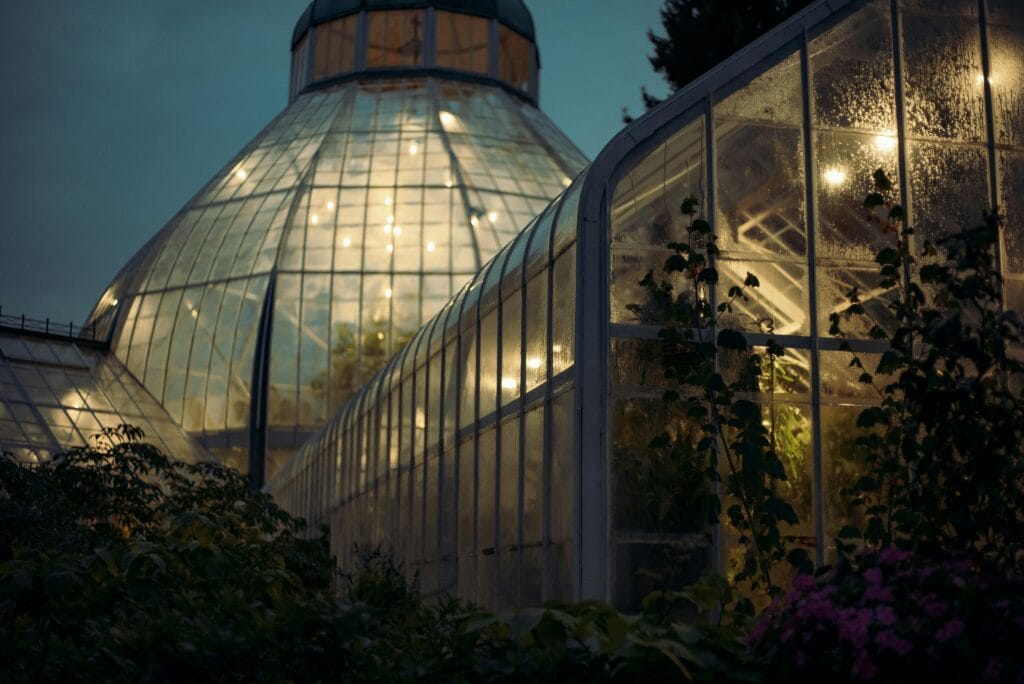
Friðheimar is a working tomato farm that uses geothermal energy from the volcanic ground to grow tomatoes year-round in an Iceland that would otherwise make outdoor agriculture impossible. They’ve converted part of the greenhouse into a restaurant — you eat lunch surrounded by growing tomato plants, in a glass structure, in the middle of the Icelandic landscape.
The menu centres on tomatoes. Tomato soup with fresh bread, tomato-based pasta, tomato-infused Bloody Marys. This sounds narrow. In practice, the soup alone — made from tomatoes grown 10 metres from where you’re sitting — justifies the stop. It’s one of the most genuinely local food experiences in Iceland; a country whose food culture is often overshadowed by its landscapes.
They also breed Icelandic horses on the property. The horses are visible from the restaurant windows.
Practical details:
- Booking required — tables fill quickly, especially in summer. Book 5–7 days ahead online via fridheimar.is
- Lunch service runs approximately 12:00–16:00 [VERIFY: current hours]
- Cost: approximately ISK 3,500–5,500 per person for the tomato soup + bread starter course [VERIFY: current menu pricing]
- Located on Route 35, approximately 6 km north of Geysir — 10 minutes by car
Why most visitors skip it: No guided tour includes it. It requires a reservation. Without both of those facts being known in advance, it simply doesn’t exist in most people’s Golden Circle planning. Now you know. Book the table before you leave home.
Hidden Stop #4: Fontana Geothermal Baths — The Quieter Alternative (15 min from Þingvellir)
The Blue Lagoon is Iceland’s most famous geothermal bathing experience. It’s also one of Iceland’s most expensive and crowded — approximately $50–120 USD per person depending on package, with timed entry slots that book out weeks in advance.
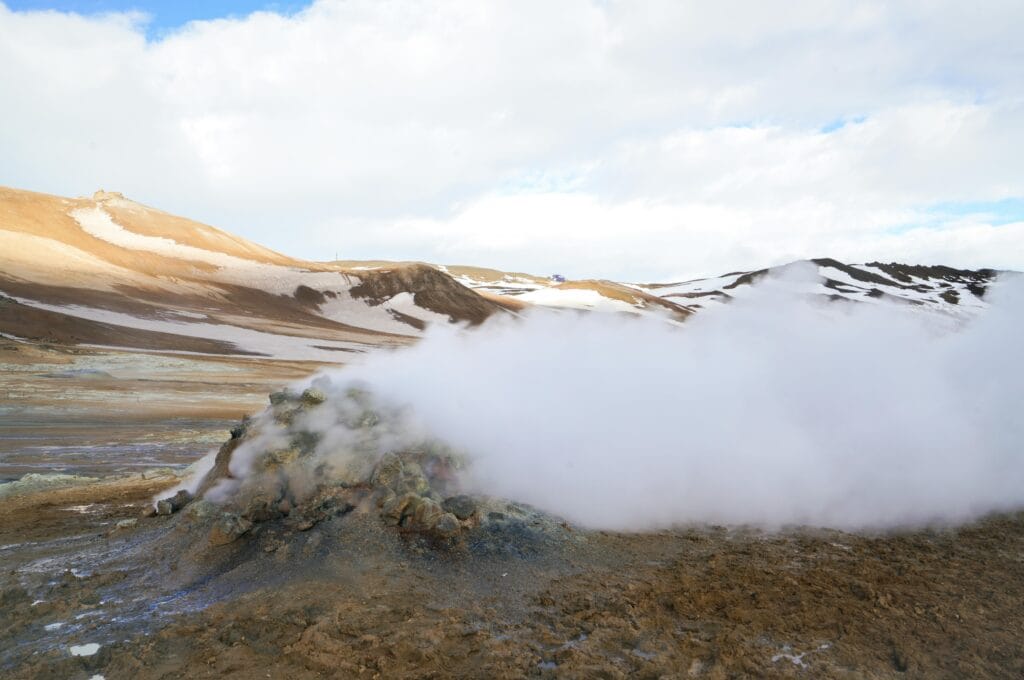
Fontana is located at Laugarvatn, on the Golden Circle route between Þingvellir and Geysir — 15 minutes from Þingvellir, 20 minutes from Geysir. It sits directly on the edge of Lake Laugarvatn, with outdoor pools heated by natural geothermal springs.
The experience Fontana offers that the Blue Lagoon cannot: rye bread baked in geothermal sand. The traditional Icelandic hverabrauð — dark, dense rye bread — is cooked in sealed pots buried in the geothermally heated black sand on the lake shore. Fontana digs the bread out and serves it warm with Icelandic butter. It’s a food ritual that predates tourism in Iceland by several centuries. They do it at scheduled times throughout the day; ask at reception for the next demonstration when you arrive.
Practical details:
- Entry: approximately ISK 3,490 per adult ($25 USD) [VERIFY: current entry pricing]
- No pre-booking required, but popular in peak summer
- Towel rental available on site
- The lake swimming is possible in summer — the lake water is cold but the geothermal pools are warm
- The bread demonstration is free with entry
Fontana works as a late-afternoon wind-down stop after the crater and geysers — the pools are the right ending for a long Golden Circle day.
The Full Enhanced Golden Circle: Hour-by-Hour Plan
This itinerary fits all seven stops into a single long summer day. Departure from Reykjavik city centre.
| Time | Stop | Duration | Notes |
|---|---|---|---|
| 6:00 AM | Depart Reykjavik | — | Early departure essential for full itinerary |
| 7:15 AM | Þingvellir National Park | 75 min | Lögberg, Almannagjá gorge walk |
| 8:30 AM | Silfra Snorkel | 3 hours | Meeting point inside Þingvellir park |
| 12:00 PM | Drive to Laugarvatn | 15 min | — |
| 12:15 PM | Fontana Geothermal Baths | 60–75 min | Rye bread demonstration + pools |
| 1:30 PM | Drive to Friðheimar | 20 min | — |
| 2:00 PM | Friðheimar Greenhouse Lunch | 60 min | Reservation required in advance |
| 3:15 PM | Drive to Geysir | 10 min | — |
| 3:30 PM | Geysir Hot Spring Area | 45 min | Stand southwest of Strokkur |
| 4:15 PM | Drive to Kerið | 15 min | — |
| 4:30 PM | Kerið Volcanic Crater | 35 min | Rim walk + descent to lake |
| 5:15 PM | Drive to Gullfoss | 25 min | — |
| 5:45 PM | Gullfoss Waterfall | 60 min | Lower path mandatory |
| 7:00 PM | Drive back to Reykjavik | 90 min | — |
| 8:30 PM | Arrive Reykjavik | — | — |
Total distance: approximately 260 km
Total driving time: approximately 4 hours
Total active time: approximately 8.5 hours
This is a full day. It’s not rushed — each stop has a realistic time allocation — but it requires the early 6 AM departure and no significant unplanned detours. The Silfra tour anchor determines everything else: once that 3-hour window is locked in, the remaining stops build around it.
Summer-specific note: Iceland in June–August has near-continuous daylight. The 8:30 PM return to Reykjavik is in full light. There’s no time pressure from darkness. Winter visitors operating on 4–5 hours of daylight will need to cut 1–2 stops from this plan — prioritise Silfra, Geysir, and Gullfoss.

Self-Drive vs. Guided Tour: Why Self-Drive Wins for This Itinerary
There’s no version of this enhanced itinerary that works on a guided bus tour. That’s not a criticism of guided tours — it’s a structural fact. Silfra requires a specific 3-hour booking window. Friðheimar requires a reservation. Fontana requires flexible arrival timing for the bread demonstration. Bus tours accommodate none of these.
Self-drive requirements:
Car type: A standard 2WD vehicle handles the Golden Circle loop in summer. The roads are paved throughout. 4WD is not required for this route in the summer months. In winter — November through March — 4WD and winter tyres are strongly advisable for safety on ice-covered roads.
Driving in Iceland: Road signs are in Icelandic and English. Speed limits are 90 km/h on paved roads, 80 km/h on gravel. Single-lane bridges require giving way to oncoming traffic. These are the main rules that differ from continental driving. Otherwise, Iceland drives on the right.
Fuel: Fill up in Reykjavik before departure. There are petrol stations at Selfoss and Laugarvatn on the route, but don’t rely on finding a station when you need one.
Rental car: Book in advance through Reykjavik airport (KEF) or city-centre rental offices. Standard vehicles: ISK 8,000–12,000/day ($55–85 USD). SUVs and 4WD: ISK 15,000–25,000/day ($105–175 USD). [VERIFY: current rental pricing]
One honest note on guided tours: If the standard three-stop Golden Circle is your primary goal and you don’t want to book Silfra in advance, a guided tour is a perfectly good format for the core route. The Kerið and Fontana stops can sometimes be found on extended guided Golden Circle tours — check tour descriptions carefully before booking.
For the full enhanced itinerary with Silfra, self-drive is the only format that works.

Does This Pair With the South Coast or Glacier Hike?
If you’re building a multi-day Iceland itinerary, the Golden Circle and the South Coast make a natural two-day structure.
Day 1 (Golden Circle + Silfra): Þingvellir, Silfra, Fontana, Friðheimar, Geysir, Kerið, Gullfoss. Base: Selfoss or Laugarvatn overnight.
Day 2 (South Coast): Seljalandsfoss, Skógafoss, Sólheimajökull glacier hike, black sand beach at Reynisfjara. The Sólheimajökull small-group glacier hike sits 30 minutes east of Vík — the detailed guide on what to expect on the ice, what gear is provided, and how the blue ice compression works is covered in our Sólheimajökull Glacier Hike 2026 guide.
Winter addition: If you’re visiting between November and February, northern lights hunting is the obvious evening activity after either day. The full breakdown of which aurora operators actually chase clouds versus which ones just hope for clear skies is in our Iceland Northern Lights 2026 guide. Glacier hikes run during the available winter daylight, auroras run at night — the two don’t compete for the same hours.
Booking Checklist: What Needs to Be Done Before You Arrive
Two stops require advance booking. Two pay at the gate. Here’s the complete list.
Book in advance — essential:
Silfra Snorkelling (2–3 weeks ahead in summer) Summer slots fill quickly. July and August in particular book out 2–3 weeks ahead. Don’t leave this until you land in Reykjavik. → Book the Silfra Self-Drive Snorkelling Tour on Viator — drysuit, thermal layers, snorkel kit all included. Instant confirmation, free cancellation.
Friðheimar Greenhouse Restaurant (5–7 days ahead) Book directly at fridheimar.is. Tables for the lunch service fill up, especially on weekend days. Have your Golden Circle date confirmed before booking.
Pay at the gate — no advance booking:
Kerið Volcanic Crater 700 ISK / approximately $5 USD. Pay at the entrance gate. No queues typically.
Fontana Geothermal Baths Approximately ISK 3,490 per adult. Arrive without booking. Busy in peak summer but not typically sold out for walk-ins.
Car rental (book as early as possible) Reykjavik rental offices. Book weeks in advance in summer — fleet availability drops quickly in June–August and prices rise with demand.
Sólheimajökull Glacier Hike (if adding South Coast Day 2) Book through Viator. Small-group format fills ahead in summer. → Book the Sólheimajökull Small-Group Glacier Hike on Viator
For the complete range of bookable Iceland experiences — from Silfra and glacier hikes to whale watching and Golden Circle tours — browse the Iceland Bucket List collection on Viator.

Frequently Asked Questions
Is the Golden Circle worth doing as a self-drive in winter?
Yes, with caveats. The three core stops are accessible year-round. Silfra runs year-round — winter is actually excellent for Silfra as the drysuit handles the water temperature and crowds are significantly lower. Kerið and Fontana are open in winter. Friðheimar operates year-round. The difference: 4–5 hours of usable daylight in December means you’ll complete 3–4 stops rather than 7. Prioritise Silfra, Geysir, and Gullfoss if operating on a winter schedule.
How far is the Golden Circle from Reykjavik?
The loop is approximately 230 km starting and ending in Reykjavik. Total driving time without stops: approximately 3–3.5 hours. With stops, the standard three-stop itinerary runs 8–9 hours. The enhanced seven-stop version runs a full day from 6 AM to 8:30 PM.
Do I need a 4WD for the Golden Circle?
No — in summer (May–September). The Golden Circle route is entirely paved and accessible in a standard 2WD. In winter, 4WD with winter tyres is strongly recommended for safety on potentially icy roads.
Is Silfra cold? Can anyone do it?
The water is 2–4°C year-round. The provided drysuit keeps your body dry; only your face is exposed to the water. Verified travellers consistently report that the cold was less of an issue than expected. A swimming ability requirement applies — you must be comfortable in open water. Minimum age is approximately 12 years. [VERIFY: exact minimum from Viator listing]
Can I do Silfra without snorkelling experience?
Yes. No prior snorkelling experience is required. The guide provides a full equipment briefing and technique demonstration before entering the water. The fissure is snorkel-depth — no diving certification needed.
What time does Strokkur erupt?
Strokkur erupts approximately every 5–10 minutes. There’s no fixed schedule. Stand and wait — you’ll see multiple eruptions within 20 minutes. Position yourself southwest of the geyser for the best unobstructed view.
Is the Friðheimar restaurant expensive?
Mid-range by Reykjavik standards. The tomato soup and bread starter is approximately ISK 2,500–3,500. A full lunch with drinks runs ISK 5,000–7,000 per person ($35–50 USD). [VERIFY: current menu pricing] Cheaper than most Reykjavik city-centre restaurants of equivalent quality.

The Bottom Line
The standard Golden Circle is a genuinely excellent day. Strokkur erupts reliably. Gullfoss is legitimately dramatic. Þingvellir is historically significant in a way that the information boards only partially convey.
But the format most visitors use — guided bus, three stops, fixed timing — makes it impossible to go beyond the core three. Self-drive changes that. And when you self-drive, four additional stops that most tourists never encounter become straightforward additions to a day that was already good.
Silfra is the one that requires advance booking and delivers the experience most unlike anything else on the route. Two continental plates. Water clarity that doesn’t exist in most of the world. A fissure that didn’t exist 10,000 years ago. Book that first. Build everything else around it.
→ Book the Silfra Snorkelling Tour — Viator Instant Confirmation
The other three hidden stops — Kerið, Friðheimar, Fontana — need no advance booking. Just knowing they exist is the entire preparation required.
About This Guide
This guide was built from analysis of [VERIFY: current review count] verified traveller reviews across Viator’s Iceland tour listings, cross-referenced with Iceland Tourism Board Golden Circle data, Visit Iceland regional guides, and verified pricing information for Fontana, Kerið, and Friðheimar. No personal claims of on-site experience are made. All pricing data reflects rates available at time of publication and should be confirmed at booking or directly with each attraction. We earn a small affiliate commission if you book through links in this guide, at no extra cost to you.